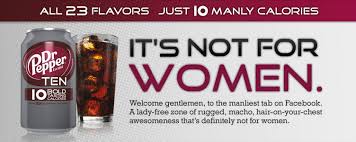
Dr. Pepper's website currently advertises 9 different options under its products category, each containing a different calorie count, flavor, or caffeine level that make it unique from the original flavor. In 2011, the popular soft drink brand released its newest concoction Dr. Pepper 10, a drink that was created to target the calorie-conscious male and allow him to avoid its feminine counterpart, Diet Dr. Pepper. The website allows users to access the nutritional information of the product, as well as an additional information section where advertisers give the reader a brief description of the product. Under Dr. Pepper 10's information section, the company writes "10 bold tasting calories with the same authentic 23 flavors of Dr. Pepper. That's a whole lot of taste in one can. Try it today." In comparison, Diet Dr. Pepper's information section reads "A satisfying diet drink does exist! Diet Dr. Pepper offers the same 23 flavors of regular Dr. Pepper, without the calories. Try one today and enjoy the unbelievably satisfying taste." In these two examples, you can see that advertisers are sending both genders the same message, but in different ways. With the more masculine diet drink option, the wording is shorter and to the point. Instead of simply saying "Try it today" in the diet Dr. Pepper advertisement, the company writes "Try one today and enjoy the unbelievably satisfying taste."
The company has also been overt in the television commercials it has created for both Dr. Pepper 10 and Diet Dr. Pepper. In
this advertisment for Dr. Pepper 10, the scene screams masculinity; a muscular male is seen shooting guns, explosions are ringing in the background, and he even addresses women and says that they can "keep their romantic comedies and lady drinks." The
commercial I found for Diet Dr. Pepper shows a bride and her bridesmaids preparing for her special day, with the bridesmaids finally no longer having to sacrifice during this time with they exchange their usual Dr. Pepper with Diet Dr. Pepper.
This collection of advertisements reminded me of Susan Bordo's article "Pills and Power Tools." In this piece, Bordo discusses the terminology used for the male reproductive organs. Blow torch, bolt, hand tool, hardware, hammer, rocket, etc. are terms that are deemed as allowable because they allow the man to maintain his masculine, aggressive in nature appearance when described using these terms. If the media continues to reinforce the aggressive vision of the male, as well as if terminology used to describe this gender remains violent, the male species will continue to be viewed as aggressors.

I think one observation that should be made about this is that the diet drink marketed to women has no calories, yet men are allowed to have calories in their "diet" drink. Along with the aggressive vision of masculinity shown in the Dr. Pepper 10 commercials, this shows that, even with diet drinks, it is acceptable for men to consume more calories than women. As the poem we watched in class said "Men are taught to grow out while women grow in."
ReplyDeleteI feel like a lot of times today I come across so many ads in the media now that I never thought were gender racist that have shown themselves to be. So many commercials are becoming a lot more aggressive about showing the differences between men and women. This Dr. Pepper commercial is a perfect example of how the media takes control of our gender and twists and molds it until they see fit.
ReplyDeleteI just recently overheard a car commercial playing on TV about a young woman who was in the market to buy a new car and was discussing how a certain website helped her out so much in purchasing her new car. While the commercial was great and entertaining there was one comment that I felt really played in to the molding of gender norms through media that we believe and hold true in our society.
The comment she made was something along the lines of “Going into car dealerships is intimidating, I try to hold my own but I can’t”, This showed the weakness of women that many men hold to be true. Her next line was “I felt like I needed a man there to help me through the process and tell me which car to get” This quote confirms the stigma that we have of men as being in charge and all about cars and what we think are manly things. Who said that a woman couldn’t hold her own at a car dealership, why do we need a man to help us? It is commercials like these and commercials like the Dr. Pepper one that Samantha mentioned that try to shape our culture and enforce those gender norms telling us what we can and cannot do. These examples strongly relate to “The social construction of gender” by Judith Lorber when she says that the process of gendering and its outcomes are legitimated by societies entire set of values.
This is a great real-life example of corporations marketing based on gender roles, and Dr. Pepper is not the only culprit. While more subtle, Coca Cola (the maker of Dr. Pepper) does the same thing with its Coke Zero product. I believe that Coca Cola saw a trend that men were not buying their original calorie free drink - Diet Coke - as much as women were. Upon realizing this, they concocted a drink that they could better market to males. If you actually look at the labels on Diet Coke and Coke Zero, they contain the EXACT same ingredients, just in slightly different order. The main difference is how the product is presented: Diet Coke is full of dainty cursive writing and swirls, while the Coke Zero can is black and the “zero” is in a bold print font. The commercials for Coke Zero also take a masculine tone, one featuring a plot involving video games, which is a mostly male hobby.
ReplyDeleteWhen a man chooses to drink Coke Zero over Diet Coke, in a small way he is “doing gender” as Michael Messner discusses in his article “Becoming 100% Straight.” I know from experience that when a guy gets diet soda at a restaurant, he is at risk at getting called a “pussy” as the movie “Tough Guise” describes. On the other hand, opting for a Coke Zero would likely not garner the same reaction from his peers. Coca Cola’s actions with Dr. Pepper 10 and Coke Zero point to a bigger problem in society, in which one’s sexuality could be questioned based on what soda he or she chooses to drink.
Good post, I enjoyed reading it! I think it's interesting and also brilliant that Dr. Pepper is able to make more profit selling a diet drink with only ten extra calories and it is supposed to be considered manly. I have never had a taste test between the two sodas before but I really cannot imagine there being a significant taste change between the two that would make the second drink for satisfying for men. The add pictured in the article that states "IT'S NOT FOR WOMEN" reminds me of the poem posted on blackboard of the girl reading a poem on stage. At one point in the poem she states that her mom sneaks downstairs at night to eat plain yogurt yet does not think she deserves it. Dr. Pepper is only reassuring that notion that women must stay thin and men should grow out by stating women cannot drink the soda with ten extra calories because that soda is for men only. Dr. Pepper is essentially advertising women should not drink or do not deserve the ten extra calories.
ReplyDeletePersonally, I do not consider diet soda a girly drink so the advertisement campaigns launched at men for a better, low calorie soda I see as mostly pointless and stupid. I do not see men thinking the soda with ten extra calories will me more manly.
Advertising companies love playing off gender roles and gender stereotypes. Take the entirety of the Old Spice line of commercials, those are so masculine is almost hurts. Hilarious, yes, and extremely well put together, yes, but very much playing off of gender roles in order to get you to buy their product.
ReplyDeleteI think the question of gender roles in modern marketing is an interesting one. In the business market, one has to maintain a competitive nature, and if advertising like this gets the job done, then it is certainly a sacrifice I would be willing to make (ideally, we assume that their one and only goal is to continue making money).
The more interesting question then becomes: Are the companies doing this kind of advertising fully aware of the extent that it may affect the audience, and if so, would they continue running such ads? Or, perhaps more likely, they are just taking part in their own gender role (an unconscious act, as most of us see it). In essence, can we really put the heavy blame of perpetuating gender roles on the company, when the gender role itself is so ingrained in our society that it is a normal and acceptable method of doing things.
It may seem silly, but it seems to be a much more grey area of ideas, rather than the typical black and white scenarios we look at. Especially with no one person being at fault within the company, since ads are made by a group, if not hundreds of people at these larger companies. They may not agree with its content/subliminal message, but we are, traditionally, taking it as a single entity.
An interesting topic. Thanks for sharing!
Regards,
Hunter Smith
I always laugh when I see this terrible ad on TV, so I'm glad someone was able to tie it into a blog post. I think this ad is offensive to both women and men, and I'm really surprised this line of advertising hasn't hurt the company's success. I think the whole idea of Dr. Pepper 10 is offensive to men, because it implies that 1.) we need to be told what kind of soda is acceptable to drink, and 2.) if we drink diet soda, we are feminine. I think Dr. Pepper 10 is offensive to women for obvious reasons, namely the idea that women are essentially excluded from drinking this beverage. Maybe this is some sort of reverse-psychology that enforces the idea of "you want what you can't have", and is driving women to guzzle down Dr. Pepper 10.
ReplyDeleteAs I mentioned above, I thought this advertisement could really hurt Dr. Pepper's stock and brand name, but in an article I stumbled upon, it seems to be doing just the opposite. http://www.cnbc.com/id/100691083 claims that Dr. Pepper is launching 10 calorie versions of their other sodas like 7-Up and Sunkist due to the success of Dr. Pepper 10. The article goes on to say that more than half of Dr. Pepper 10's drinkers are people who had given up soda in the past. What this article means to me is that gender advertising, no matter how stupid or offensive it may be, works. Men will drink a low calorie soda if they are told that it is manly and masculine, and apparently some women will drink a soda out of spite perhaps, for being told that "It's not for women".